When people contact us about certified document translation, one of the most common questions we hear is:
“Where can I bring my documents for translation?”
It’s a fair question. For many years, translation services operated from physical offices where documents were dropped off and picked up later.
Today, however, most professionally certified document translations are completed digitally.
At Steven Mobile Notary, we operate as a mobile, digital-first service, so we do not maintain a walk-in office for translation requests. Instead, documents are securely submitted online and translated through our professional network of qualified translators.
For many clients, this approach is actually faster, more convenient, and just as widely accepted by institutions reviewing translated documents.
What Is a Certified Document Translation?
A certified document translation is a translated document that includes a signed certification statement confirming that:
- The translation is accurate and complete
- The translator is competent in both languages
- The translation faithfully reflects the original document
Certified translations are commonly required for:
- immigration applications
- academic transcripts and diplomas
- birth certificates
- marriage certificates
- divorce decrees
- court filings
- government documentation
Several government agencies mandate the inclusion of a certified translation to verify the accuracy of any foreign-language document they receive.
How Our Certified Document Translation Process Works
1. Submit Your Document
Clients submit a clear scan or photo of the document.
Common documents include:
- birth certificates
- marriage certificates
- divorce decrees
- academic transcripts
- diplomas
- legal documents
- immigration documents
In many cases, a clear smartphone photo is perfectly acceptable as long as the text is legible.
2. The Certified Translation Is Prepared
The document is translated by a qualified professional translator who prepares the translated document along with a translator’s certification statement confirming the accuracy of the translation.
This certification is the key element that makes the document a certified translation.
3. The Certification Can Be Notarized
In some situations, the translator’s certification may also be notarized.
A notary public verifies the identity of the translator signing the certification statement. The notary does not certify the translation itself but confirms that the translator has sworn to the accuracy of the translation.
This additional step can provide an extra layer of verification when documents are being used in legal or international contexts.
Are Certified Translation PDFs Accepted?
In many cases, certified document translations delivered digitally as PDF files are widely accepted.
Organizations reviewing translated documents generally focus on whether the translation includes:
- the full translated document
- the translator’s certification statement
- the translator’s signature
These elements demonstrate that the translation meets certification standards.
Because requirements vary between institutions and countries, we always recommend confirming with the receiving authority if they require a printed or physically signed copy.
When a Certified Translation Leads to an Apostille
Some documents translated for international use may require additional authentication through an apostille.
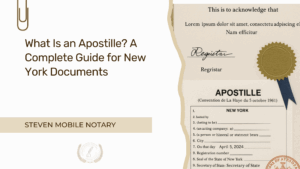
An apostille is a certificate issued by a government authority that verifies the authenticity of a notarized document so it can be recognized in another country that is part of the Hague Apostille Convention.
In those situations, the process may follow a path like this:
- The document is translated by a certified translation service.
- The translator’s certification is notarized.
- The notarized document may then qualify for apostille authentication.
This process allows documents such as birth certificates, marriage certificates, academic records, and legal documents to be recognized internationally.
Certified Document Translation in Over 130 Languages
Through our translation network, we assist clients with certified document translation in more than 130 languages, including:
Spanish
French
Portuguese
Russian
Arabic
Chinese
Korean
Hebrew
Yiddish
and many others.
These translations are commonly used for immigration filings, legal matters, academic institutions, and international documentation.
A Modern Approach to Document Translation
While many people still imagine visiting a physical office for translation services, the industry has evolved significantly.
Today, secure digital submission allows certified translations to be prepared quickly and delivered electronically while still meeting the requirements of many organizations and institutions.
Our goal is to keep the process simple, efficient, and accessible, whether the document is being prepared for immigration, legal use, education, or international recognition.
Citations & References
U.S. Citizenship and Immigration Services (USCIS). Translation Requirements for Foreign Language Documents.
https://www.uscis.gov
American Translators Association (ATA). Guidance on Certified Translation and Translator Certification.
https://www.atanet.org
Hague Conference on Private International Law. The Apostille Convention Explained.
https://www.hcch.net
U.S. Department of State. Authentication and Apostille Services for Documents Used Abroad.
https://travel.state.gov