Certified Documents Vs Sworn Document Translations
A common assumption is that once a document is translated and certified, it will be accepted without issue anywhere it is submitted. In practice, that assumption is often tested when the document reaches a foreign authority for review.
Translation requirements are not uniform across borders. Each country applies its own legal standards, which shape how translated documents are prepared and presented. A format that works for U.S. immigration, courts, or educational institutions may fall short when reviewed by a foreign government agency, court, or registrar.
This article is not intended to replace official guidance or outline government procedures. Its purpose is to explain what may be required based on the destination country, and why determining whether a certified or sworn translation is needed can influence whether a document is accepted or sent back for correction.
As always, acceptance rests with the receiving authority.
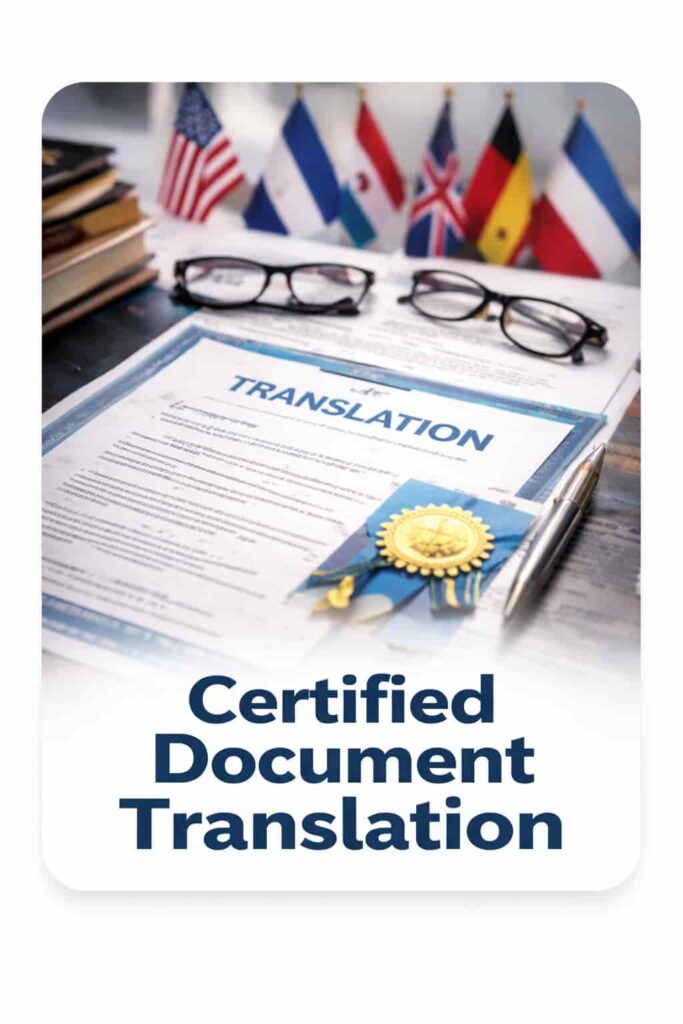
Certified Document Translations in the United States
Within the United States, a certified translation typically includes a complete and accurate translation accompanied by a signed statement from the translator confirming its accuracy.
This format is commonly accepted by U.S. immigration authorities, courts, educational institutions, and licensing agencies. The U.S. system places emphasis on the translator’s declaration rather than formal government appointment or court authorization.
For many domestic uses—and for some international filings — a U.S.-certified translation is sufficient. That said, this approach reflects U.S. legal practice and does not automatically align with requirements imposed elsewhere.
Sworn Translations in Civil-Law Countries
Outside the United States, many countries operate under civil-law systems that apply a different standard.
A sworn translation is prepared by a translator who has been formally authorized by a court or government authority in the destination country. These translators have sworn an oath, and their translations are legally valid in the area where they work.
In these jurisdictions, acceptance is tied less to how well the translation reads and more to whether the translator holds recognized legal authority. For that reason, a U.S.-certified translation may be declined even when the translation itself is accurate and professionally prepared.
Countries That Commonly Require Sworn Translations
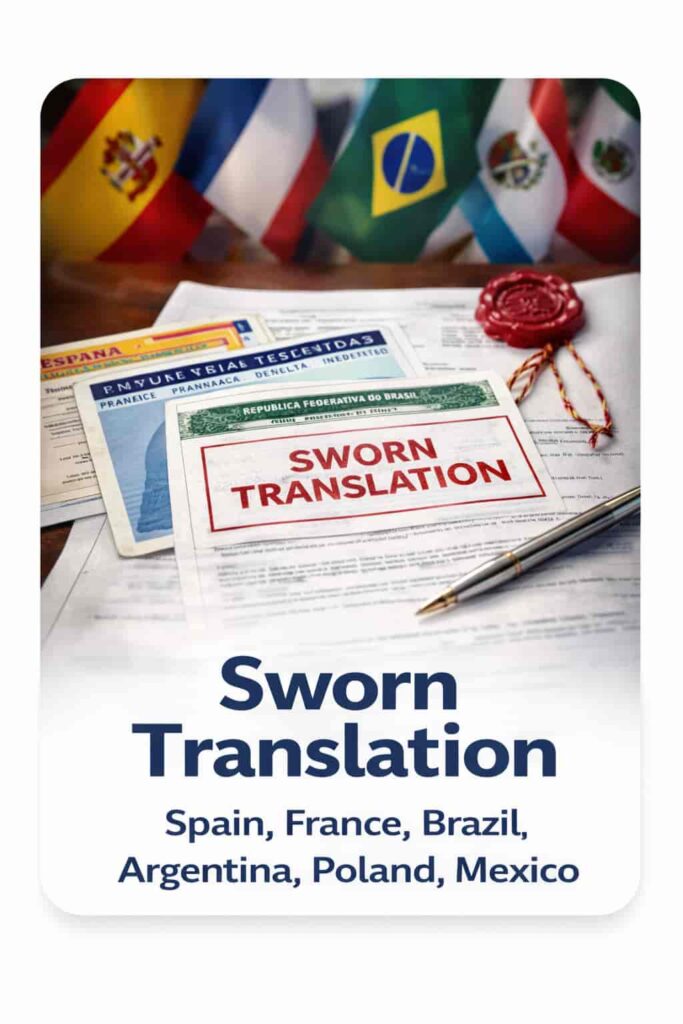
Although requirements can vary by institution and document type, sworn translations are frequently required in civil-law jurisdictions such as:
- Spain
- France
- Brazil
- Czech Republic
- Argentina
- Poland
- Mexico
- Honduras
- United Arab Emirates
In these countries, courts, universities, registrars, and government agencies often require translations issued by sworn translators who appear on official court or government registries.
Even when a document originates in the United States, the translation is still evaluated under the legal standards of the destination country.
Where Sworn Translators Are Typically Based
Sworn translators are usually based in the country where the document will be submitted.
They operate under local law, are listed with national or regional authorities, and remain subject to that country’s professional and legal oversight. As a result, sworn translations are most often issued within the destination country rather than abroad.
In recent years, many sworn translators have moved toward issuing translations electronically using legally recognized digital signatures. Where electronic signatures are accepted, these digital translations carry the same legal effect as traditional wet-signature versions.
How Translation Requirements Intersect With Apostilles
Translation and apostilles address different parts of the international document process, but they often intersect.
An apostille authenticates the origin of a public document so it can be recognized in another country. It does not confirm the accuracy of a translation or determine whether a translated document will be accepted.
Translation acceptance is evaluated separately by the receiving country or institution.
Depending on the destination and the document type, a document may need to be apostilled before being translated by a sworn translator, or the translation itself may require additional authentication or legalization. The appropriate sequence depends on the destination country and the authority reviewing the document.
Acceptance Always Comes First
Urgency does not change acceptance standards.
Before proceeding, it is important to account for:
- The destination country
- The specific institution reviewing the document
- Whether a sworn translation is required
- Whether electronic formats are accepted
- Whether the document falls under international apostille agreements
When acceptance is not clarified in advance, documents are often delayed, rejected, or returned for additional work.
How We Approach International Translation Matters
Our role is not to provide a checklist or encourage trial-and-error.
In international translation matters, we focus on:
- Reviewing destination-country requirements
- Determining whether certified or sworn translation is appropriate
- Coordinating sworn translators in the destination country when required
- Aligning translation, notarization, and apostille considerations
- Setting realistic expectations around timing and acceptance
Each matter is evaluated on its own facts. There is no universal solution that applies to every case.
Final Thought
Certified translations and sworn translations are often confused because the terminology sounds similar. In practice, they operate under different legal systems and serve different acceptance standards.
Clarifying what is required before submission can prevent delays, added expense, and avoidable resubmissions — particularly when international deadlines are involved.
We focus on approaches grounded in acceptance, not assumptions, and move forward only when the receiving authority’s requirements support the path being taken.
Sources & References
- U.S. Citizenship and Immigration Services (USCIS)
https://www.uscis.gov/forms/filing-guidance/translations - American Translators Association (ATA)
https://www.atanet.org/client-assistance/what-is-a-certified-translation/ - Ministry of Foreign Affairs of Spain
https://www.exteriores.gob.es/en/ServiciosAlCiudadano/Paginas/Traductores-Interpretes-Jurados.aspx - Cour de Cassation (France)
https://www.courdecassation.fr/services/traducteurs-interpretes - Junta Comercial (Brazil)
https://www.gov.br/empresas-e-negocios/pt-br/redesim/juntas-comerciais - Hague Conference on Private International Law (HCCH)
https://www.hcch.net/en/instruments/conventions/specialised-sections/apostille